Basic Use
COMPUTE v1 = RV.NORMAL(0,1).
Summary
In SPSS, RV is short for random variable. It draws random values from a given probability distribution. The latter is specified as a period separated suffix as in RV.BERNOULLI(.5).RV is mostly but not necessarily used with COMPUTE.
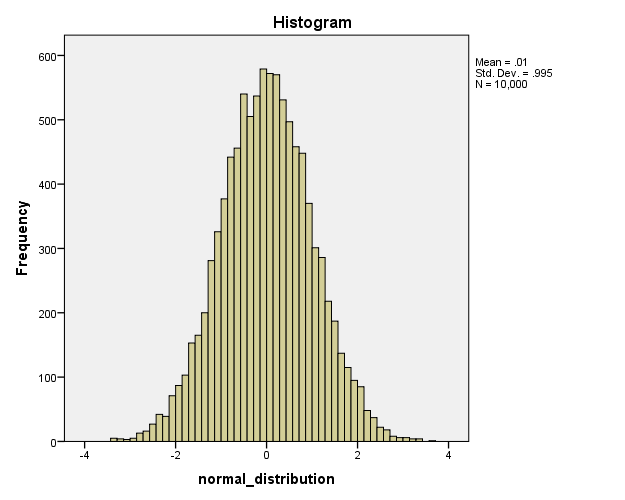 Random Sample (N = 10,000) from a Standard Normal Distribution
SPSS Rv Examples
A nice way to get familiar with some common probability distributions is to visualize them. The syntax below does this by computing random variables from different distributions and creating their histograms with FREQUENCIES. After running it, we’ll briefly walk through the distributions we visualized.
SPSS Rv Syntax Examples
input program.
loop id = 1 to 1e4. /* 1e4 is short for 1 * 10**4 (= 10,000).
end case.
end loop.
end file.
end input program.*2. Normal (Gaussian) distribution.
compute normal_distribution = rv.normal(0,1).frequencies normal_distribution/histogram/format notable.
*3. Uniform distribution.
compute uniform_distribution = rv.uniform(0,5).
frequencies uniform_distribution/histogram/format notable.
*4. Bernoulli distribution.
compute bernoulli_distribution = rv.bernoulli(.3).
frequencies bernoulli_distribution/histogram/format notable.
*5. Binomial distribution.
compute binomial_distribution = rv.binom(5,.5).
frequencies binomial_distribution/histogram/format notable.
Common Probability Distributions
RV.NORMAL(mean,SD)is used for drawing values from a Gaussian (“normal”) distribution.RV.NORMAL(0,1)returns random values from the standard normal distribution.RV.UNIFORM(mininum,maximum)draws values from a (continuous) uniform distribution. This means that all values have the same chance of occurring. An example are throws with a balanced die: values 1 through 6 all have the same chance of (1/6) of occurring. This can be simulated byTRUNC(RV.UNIFORM(1,7)). The fractional values are discretized here by truncating them.RV.BERNOULLI(probability)results in only zeroes and ones where the probability denotes the probability of drawing a one. For simulating flips with a balanced coin, useRV.BERNOULLI(.5).RV.BINOM(attempts,probability)returns the (discrete) number of “successes” given the probability of succes and the number of attempts. An example is the number of heads that come up when 5 coins are flipped. The result can be anything from 0 through 5. Therefore,RV.BINOM(5,.5)returns numbers from 0 through 5 as if they resulted from this experiment.
Final Notes
- For more probability distribution functions, consult the command syntax reference under “Universals”.
- Related to the
RVfunction is theCDF(Cumulative Distribution Function). This returns the cumulative probability given a test statistic value and probability distribution. - Also related to the
RVandCDFfunctions isIDF(Inverse Distribution Function). It returns the test statistic value, given a cumulative probability and probability distribution. - You could write
NORMAL(1)instead ofRV.NORMAL(0,1)andUNIFORM(1)forRV.UNIFORM(0,1). This notation was used in SPSS versions 5 and below and still works for backward compatibility. We find it not very readable or intuitive and therefore rather avoid it.